

Museu da UFPA


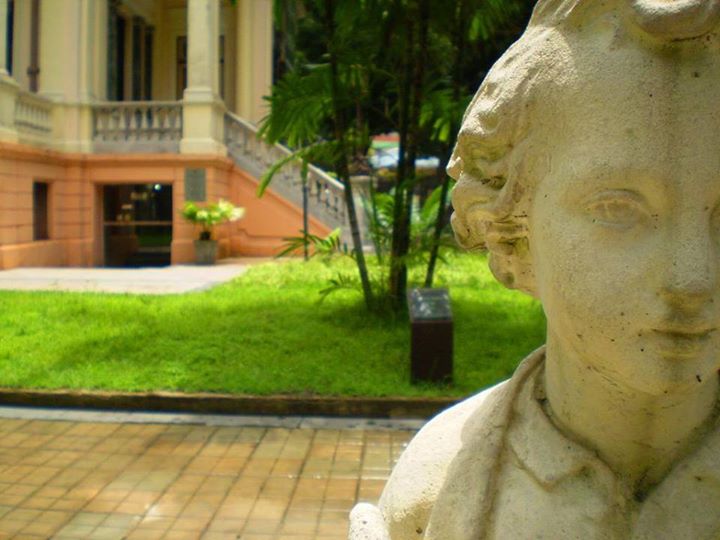
The museum of the Federal University of Pará was created in the 1980s to identify, disseminate, preserve and enhance regional and national artistic production. The building chosen to host it showed a rare attention to the eclectic architecture that had emerged in the Amazon as one of the most important consequences of the so-called rubber cycle. Having as its first occupant the governor Augusto Montenegro, from whom he acquired the name by which he became known: Palacete Montenegro, the building was designed by the engineer Filinto Santoro by order of the governor himself. Formed by the Royal School of Naples the designer sought references in the Italian Renaissance and imported, exclusively from his country of origin, the materials for the execution of the work. It may be assumed that he employed predominantly Italian laborers as he was employed in Brazil. The grilles, external railings and frames, decorative elements and external lamps were brought from Milan, the marbles are also Italian, including the capitals of the facades. Some decorative elements of the facades, putti, lions and flowers in bulk, may have been executed on the spot, but certainly with molds or design drawings. The linings are in wood or metal. The wooden ones received elaborate compositions in the wood itself or in decorative paintings like those of "grotesque" in the living room of the main floor. The metallic ones are composed of pressed and painted plates, the dining room in petit bronze and the cabinet of the governor in meticulous decorative painting. During a long period between the years 1990 and the beginning of the years 2000 the palace suffered numerous losses in its architecture by lack of financial resources to its maintenance. The museum in this period was already in very poor condition. In 2003 the palace Augusto Montenegro is registered by the Government of the State of Pará as Historical Heritage and, in the same year, assumed as director of the MUFPA the teacher and architect Jussara Derenji. The walls were decorated in various motifs, at the simplest, ready or floral top, on the ground floor in an exuberance of motifs executed with molds. In the living room are flowers and peacocks in gold and red, in the marbled dining room painting. An exceptional case is the partition between the visitor and dining rooms. Two columns support the double arch that has a central shield with the initials of the governor. In the lateral branches of coffee and cacao, riches of Pará in the colonial period. The floors are in regional woods, as are the boiseries that replace the finishing skirtings. The design of each room is different from the previous ones and elaborated according to the importance of the environment where it is located. They differ the floors of the entrance hall, in mosaic Genoese, and those of the balconies that are in hydraulic tiles of the beginning of century XX. The references to the fleur de lys, symbol of France, which exist in the capitals, and in the external and internal decorated glass, demonstrating the attachment of the governor to that country where he lived as a cultural attache of Brazil. The hardware is in bronze and some doors have door knobs in art-nouveau design. Some elements still deserve attention. Of the original fixtures little has been preserved, however, there remain eight silver fixtures signed and referenced by the German company WF. The ladder, which starts off in strips of embedded wood, has a winding curve forming one of the most attractive points of the Museum. The building system, using metal and brick arches, is considered innovative for the time and even today it attracts the attention of engineering technicians who visit the building. Unfortunately the bathrooms were not kept in Italian marbles or the service areas of which little is known. The garden was incorporated into the complex in the years 1948-50. The family occupying the building at that stage bought six residences that were located on Generalissimo Deodoro Avenue and demolished them to build a neoclassical garden with belfries, mass statues of Belgian origin and a central fountain in which they used as a centerpiece an element of French origin. In the 60's the residence was bought by the Federal University of Pará to be the seat of the Rectory. It was then reformed and, being the period of the military dictatorship, was stripped of most of the decorative details considered unsuitable for a building of official use. In 82 the Rectory went to the Campus and the building was destined to the Museum of the UFPA created in 83 and installed in 85. Strangely, no own collection was foreseen and as a result the Museum had no technical reserve or funds to purchase works. The Museum was directed by the teachers: Jane Beltrão, Geraldo Mártires Coelho, João Mercês, Vicente Salles and Lúcia Couceiro, until the turn of the 21st century, having had various directions from art gallery to documentation center. In 2003 he takes over Jussara Derenji. The building and the institution arrived at the year 2000 in bad condition of conservation and not having minimum conditions of operation.

Book a nearby experience
